
Snake Avoidance Training for Dogs: What Veterinary Clinics Need to Know

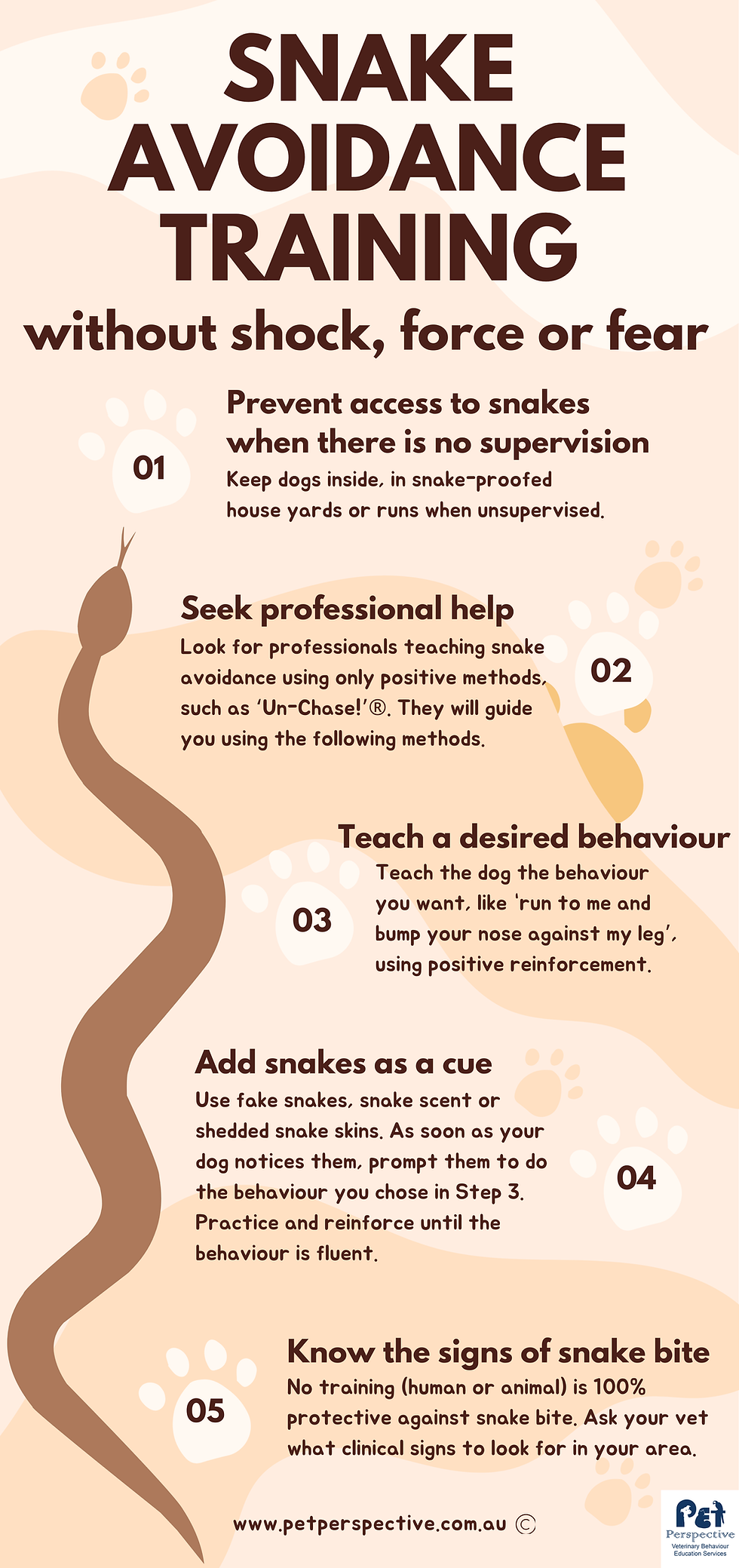
In Australia, it’s snake season, and caregivers want to know how to prevent their dogs being bitten. In this article, we will explore how to reduce the risk of snake bites, and training options for snake avoidance. There's also a free infographic to share on social media or use in your clinic!
Australian Snakes
Around 100 of our species of snakes are venomous, although only(?!) 12 species are likely to be deadly to humans or pets. These include tiger snakes, brown snakes, black snakes, death adders and taipans. The chances of encountering a snake are higher in warmer weather (from October through to March), and in regional, rural or wilderness areas. Snakes are amazing creatures in their own right and play an important role in their ecosystems. However, nobody wants their pet bitten by a snake. So, what should we do to minimise the risk to pets?
Understanding a little snake behaviour helps with preventing bites. Snakes are ectotherms, relying on the external environment to heat/cool their bodies. They can move faster when they are warmer. They start to move about more in Spring, looking for mates. They are preyed upon by birds, so prefer areas with cover to hide. They eat rodents and other small mammals, birds, other reptiles, frogs and eggs.
Preparing the Home Environment
The best way to reduce the possibility of pets getting bitten is keeping them in an area that is unappealing to snakes. We have all seen images of snakes inside people’s homes, vehicles and other unexpected locations. It is very difficult to ensure that somewhere is entirely snake-proof, but attempts should be made to reduce the availability of hides and rodents. Whenever a human is not supervising, dogs should be in an area that is as ‘snake-proof’ as possible. This may be an outdoors house-yard or dog-run with snake mesh, or indoors.
At home:
- Keep grass short and gardens tidy.
- Block holes that snakes may use to access the home.
- Keep woodpiles away from the house, store corrugated iron sheets vertically, clear away pipes and debris.
- Use rat (and snake) -proof chicken sheds and compost bins. Keep these away from the house. Turn compost regularly. Use airtight containers to store seeds and grains.
On walks:
- Walk in areas where the ground is clear, and keep dogs on leash where risk is very high.
- Avoid logs and rock piles, and make sure dogs don’t approach these areas.
Whilst reducing the likelihood of snake encounters is important, the overall welfare of the animal must be considered in each individual case. Do the benefits of the chosen form of confinement outweigh any potential reduction in welfare? For example, concrete cage runs with snake mesh are available, but in areas where snakes are active all year round, does keeping the dog safer justify the reduction in quality of life, compared to a house yard that is kept as tidy as possible but has an increased risk of an encounter? Or in a snake prone area, does the risk of a snake bite outweigh the benefits of off-leash walks for a dog?
Snake Avoidance Training Methods:
If the dog is walked off-leash or on long-lines through the bush, cane-fields, or other areas where snakes are likely to be present, then caregivers may start to consider 'Snake avoidance training'. There are currently two methods used specifically to teach dogs to avoid snakes.
Using Positive Reinforcement:
Snake avoidance training using this method has three components.
A speedy and reliable recall. If the handler is the first to detect the presence of the snake, then a reliable recall is essential. Such a recall is useful in many situations, and it is strongly encouraged that all caregivers teach their canine companions this lifesaving skill. Caregivers participating in a snake avoidance program may be encouraged to teach an entirely new recall cue, if (as is often the case!) their dog’s regular recall behaviour is not as solid as desired.
An 'alert' behaviour. The next step of snake avoidance training is in preparation for situations where the dog notices that the snake is present before the caregiver. The dog is taught to perform a desired behaviour, using positive reinforcement. Dogs may be taught to bump their nose against the caregiver’s leg, or hold a paw on the caregiver’s foot. The indication behaviour must be distinctive (so that the caregiver notices it) and unique, as well as comfortable and safe for both dog and human.
Adding the cue. The cue ‘presence of a snake’ is actually a group of different sensory cues, particularly visual and olfactory. The aim is that the cue should be generalised, so that the dog will perform the behaviour with anything that looks or smells like any kind of snake. The snake stimulus is approximated initially with wooden or rubber snakes (for visual), snake scent or shed skin, or faeces for scent detection. Fishing line can be attached to add movement. As soon as dog notices the presence of a ‘snake’, the caregiver prompts them to perform the previously taught alert behaviour.

The goal sequence is:
Dog detects presence of snake
Performs alert behaviour (e.g. runs to caregiver and puts paw on their foot)
Dog is reinforced by caregiver
Image credit: Alexis Davison
Using Positive Punishment
This is NOT a recommended method. It is possible to teach snake avoidance training (or aversion training) using positive punishment, and there are companies in Australia who promote and perform this kind of training. Dogs have an electronic/shock collar placed around their necks and are placed in an enclosed area where there is a snake (normally a lived, defanged, venomous snake). Once the dog notices and approaches the snake, the collar is remotely triggered by the trainer so that an aversive physical stimulus (shock/pain) is applied to the dog’s neck. The setup is repeated until the dog reliably avoids snakes. Again, this method is NOT recommended, because of the potential for serious side effects due to the use of punishment.
Why Positive Reinforcement?
If we examine the current evidence in behavioural science:
To date, there is no published, peer-reviewed research available on the efficacy of snake avoidance/aversion training, using punishment OR reinforcement.
Teaching snake avoidance using positive reinforcement has a sound basis and is a viable method of training.
We know that dogs can be used to detect and alert humans to the presence of various wildlife species in the field, including snakes. McKeague et al reviewed conservation detection dog articles and found that “Work with reptiles and amphibians reported rates of between 61% to 98% for sensitivity and 27% to 100% for precision”.
We know that dogs can perform trained behaviours at a distance from the handler, even beyond the handler’s line-of-sight. Examples include search and rescue dogs (and rats!), and animals used in hunting, herding or detection work.
We know that positive reinforcement can be used to teach complex behaviours, even when the stakes are high. In many countries (including Germany, France, Spain, The Netherlands, Finland, Sweden) the use of electronic collars is banned, and dogs are trained to a high level of proficiency using positive reinforcement techniques. An article comparing the efficacy of teaching recall using positive punishment vs positive reinforcement (China et al 2020) found were that less signalling was required, and there was less latency (the time between when a cue was given and the behaviour performed) with positive reinforcement training, and no significant difference in the frequency of 'disobeying'. Studies like these, as well as tried and true practical examples in dogs and other species worldwide, are the reason that I advocate for positive reinforcement methods for teaching dogs.
Snake aversion training using punishment has significant risk of creating long standing behavioural problems. There is a large body of evidence documenting the potential adverse consequences of using positive punishments to teach dogs. These risks include increased anxiety, new fears, increased risk of aggression. Dogs learn by association and although the trainer may aim to pair the shock with the snake (snakes=scary/bad) the dog may form another association (collars=scary/bad, strange men=scary/bad, traveling to new places=scary/bad, presence of other dogs=scary/bad). There is also a possibility of the dog developing a generalised anxiety. You can find more information in my previous blog about the use of punishment in training at this link
Higher levels of emotional arousal make thoughtful response to cues more difficult. Snake avoidance training using shock purports to be more effective as it develops a conditioned emotional response between the presence of snakes and a fear response, so that dogs will avoid snakes if they come across them, without even having to ‘think’ about it. However, a fear response may manifest in many different ways (think of ‘fight, flight, freeze, fiddle’). One of the ways that dogs increase distance is by aggressive displays, which may lead to a dog attacking a snake, rather than retreating from it. Additionally, the higher the emotional arousal level, the more difficult it is for the dog to concentrate on a caregiver, or remember newly taught behaviours, and the more it will fall back on habitual behaviours. If the habit for the dog is bark and/or chase, then it’s harder for them to think of an alternative behaviour.
Positive reinforcement build good relationships and strengthens the human-animal bond. Using positive reinforcement snake avoidance training gives us a great opportunity to teach people how to prevent snake encounters, understand snake behaviour, read their dog’s body language, improve their recall and in doing so strengthen their relationship with their dog.
Given that there is a more ethical alternative, with the same likelihood of efficacy, there is absolutely no reason to recommend the use of punishment to teach snake aversion. Veterinarians should NOT sign statements allowing or promoting the use of shock in any form of training.
If dedicated clients truly want to pursue training options, then positive reinforcement based snake avoidance courses are offered in snake avoidance training, here in Australia through the UnChase!® program (using the methods described above) and internationally by Ken Ramirez’s Snake course through Karen Pryor Academy, and by trainers who have been taught these methods. Additionally, resources like “Rocket Recall” and “Predation Substitute Training” by Simone Mueller provide good examples of how to build desired behaviours, using positive reinforcement. Please note, these are not affiliate links, but genuine recommendations for highly regarded professionals.
Venomous Snakebites Can Still Occur
Regardless of what training and prevention programs are put in place, snake bites can still happen. This is true for all species, including humans. Many snake encounters are accidental and occur because snakes are well camouflaged and an animal has inadvertently approached too close.
Vets should advise clients to:
Keep pets in a safe ‘snake-proof’ environment when unsupervised.
Walk dogs in areas where the ground is clear and it is easier to see a snake, if present.
Train a reliable recall using positive reinforcement
If clients are keen to pursue further training, then snake avoidance training using positive reinforcement, is possible so that the (detected) presence of a snake becomes a cue for a recall and alert behaviour chain.
Know what to do if people think their dog may been bitten by a snake
Situation | Recommendation |
Dog unsupervised | ‘Snake proof’ area
|
Dog with handler, neither detects presence of snake | Know clinical signs of snake envenomation and have vet’s number saved in phone |
Dog with handler, handler is first to detect snake | Reliable recall
|
Dog with handler, dog is first to detect snake | Snake Avoidance training using positive reinforcement techniques |
I hope you've found this article helpful! If you would like to reach out, please contact me. You can find my free infographic with download link and article references below
Here's to avoiding snake bites!
-Jen
Many thanks to Alexis Davison for her help in describing the methods used in the UnChase!® Snake Program.
References
2. Padula, A., Ong, H., & Kelers, K. (2018). Snake envenomation in domestic animal species in Australia. In Envenomations: An overview of toxins and treatment (pp. 779-795). Springer. https://doi.org/10.1007/978-94-017-7438-3_66


Comments